Products
SOUND LEVEL CALIBRATOR |
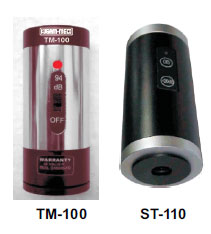
Model TM-100 (for KM 927, 928 & 929) / ST-110 (for ST-105 & ST-106) |
A Sound Level Meter is a device which measures sound pressure to determine how intense sounds are, measuring in decibels. Decibels are a logarithmic scale based on the sensitivity of the human ear. Prolonged exposure to sounds over 85 decibels can lead to hearing loss, making measurement of decibel levels important for people who work in noisy environments so that they know when they need to protect their ears. For reference, normal conversation occurs between around 40 and 60 decibels, depending on who is talking. A firecracker is about 140 decibels, and a jackhammer runs at around 100 decibels. Musicians, mechanics, construction workers, and other people who work in loud environments can endanger their hearing, especially if they work in environments with explosives, which can generate sound waves intense enough to cause pain and immediate hearing damage. A decibel meter can indicate when sound has reached the danger zone. The Sound Level meter measures the sound pressure and provides a reading in decibels for the convenience of the user. Some may also provide readings in other units of measurement, depending on the uses they are intended for. Sound Level meters are often designed to be portable so that people can move them around as needed, and are often hand held, although sometimes they can be part of a permanent instrument array which is designed to take continuous measurements in a given area. One application in which a decibel meter can be used is in the reinforcement of municipal laws. Many municipalities bar sounds above a certain decibel level for safety and comfort, and may have restrictions on noise during certain hours. Police officers can carry decibel meters to determine whether or not a sound is violating the noise ordinance. These devices are also used in noise pollution studies which are used to determine the impact of passing vehicles, aircraft, D. G. Sets and other sound-generating objects on a community. UNDERSTANDING THE DECIBEL SCALE The Sound Level Meter is also used in the music industry, during recording and setting up for concers as well as monitoring of conditions in a concert. Similarly, meters may be installed in noisy workplaces to monitor conditions, and may be designed to send out alerts when people need to wear ear protection or take other precautions to protect their hearing. These devices are also utilized in testing of hearing protection such as ear plugs and headphones, with such products coming with a decibel ratings to provide an indicator as to which setting they can and should be used in. You have to think about the decibel scale very carefully, because it’s a logarithmic scale and it works in a different way than the scale on a ruler, which is a linear scale. On a ruler, a distance of 20cm is twice as long as a distance of 10cm & 30cm is three times as long. But the logarithmic decibel scale goes up in powers of ten: every increase of 10dB on the scale is equivalent to a 10-fold increase in sound intensity (which broadly corresponds with loudness). That means a sound of 20dB is 10 times louder than a sound of 10dB and a 30dB sound is 100 times louder. A sound of 100dB is actually 1,000,000,000 times louder than a sound of 10dB and not 10 times as loud, as you might suppose. That’s why sounds high up the decibel scale (from about 85-200dB) are a major cause for concern: the sound waves carry so much energy that they will damage your hearing, sooner or later. |
|||||||||
 |
 |
||||||||
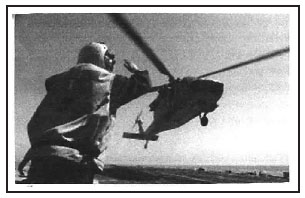
| Photo : Imagine how loud this job can get. The Landing Signal Enlisted (LSE) is the brave person who has to guide helicopters and jet airplanes safely in to land on aircraft carriers. Notice that they always wear heavy duty earmuffs to protect their hearing against jet engine noise that can exceed 150dB at such close quarters. Sound Level Meters look quite simple. |
|||||||||
| They have a pointy stick at the top, which is the microphone that samples and measures the sound. The stick keeps the microphone away from the body of the instrument, cutting out reflections, and giving a more accurate measurement. Inside the square box at the bottom of the meter, electronic circuits measure the sound detected by the microphone and amplify and filter it in various ways before showing a readout on a digital LCD display. |
|||||||||
|
|||||||||